Dr. Katrin Blamey, Ph.D. Co-Authors New Book Bringing the Science of Reading to Preschool Classrooms
 From this month’s cover story in The Atlantic titled “The End of Reading is Here” to the chorus of concerns from parents and educators alike, the national conversation on dramatic drops in reading intensifies anew as the new school year commences. But one question endures: What does reading actually look like for the youngest learners in preschool classrooms where children are just beginning to explore letters, sounds, and stories?
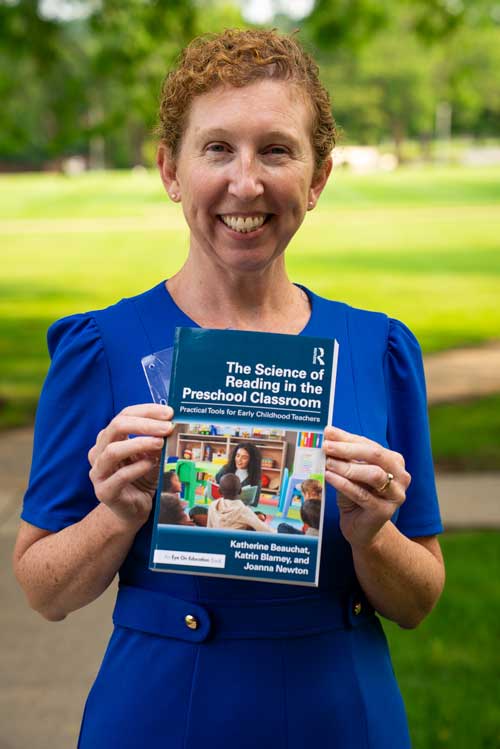
A new book co-authored by Dr. Katrin Blamey, Ph.D., associate dean of the School of Education and director of the M.Ed. Programs at DeSales University, answers that essential question.
The Science of Reading in the Preschool Classroom: Practical Tools for Early Childhood Teachers, co-written with Katherine Beauchat of Notre Dame of Maryland University and Joanna Newton, also of Notre Dame of Maryland University, is being described as the first Science of Reading resource built specifically for preschool settings. The book takes a body of research that has largely been applied to older students and translates it into practical, developmentally appropriate strategies that early childhood educators can use every day.
“I have dedicated my career to working with pre-service and in-service Educators to deliver effective, developmentally appropriate literacy instruction,” said Blamey. “This book combines what we know about effective literacy instruction with what we know about young children and the realities of the modern classroom context. I hope it helps support the important work of the Early Childhood Educators who read it.”
Drawing on her own background teaching and researching in early childhood settings, including Head Start classrooms, Dr. Blamey brings a hands-on perspective to the book's nine chapters, which move from the foundations of the Science of Reading through oral language and vocabulary development, reading comprehension, concepts of print, phonological and phonemic awareness, meaningful writing, and home-school literacy connections. A closing chapter helps teachers pull every strategy together into a cohesive, everyday approach to literacy instruction.
Rather than treating the Science of Reading as an abstract framework, the book emphasizes real classroom application. Educators will find guidance on the purpose and benefit of each strategy, how to weave new instructional routines into an already full preschool day, and how to use assessment data to differentiate instruction for children at different stages of literacy development.
The authors designed the book to serve both preservice teachers who are still training for the classroom and in-service teachers looking to strengthen their practice, offering real-world examples throughout rather than relying solely on theory.
For Dr. Blamey, the book reflects a broader mission she carries into her work at DeSales, where she helps prepare the next generation of educators through the university's M.Ed. programs. By giving preschool teachers a clear, research-backed roadmap, she hopes to shape literacy instruction at the very point where it matters most, in the earliest years of a child's education.
“Dr. Blamey's expertise in early literacy and evidence-based reading instruction, coupled with her collaboration in helping shape Pennsylvania's Structured Literacy Endorsement, makes her an exceptional voice in advancing the Science of Reading for educators,” says Erin McLaughlin, Ph.D., dean of the DeSales College of Arts, Education, and Humanities.
The Science of Reading in the Preschool Classroom: Practical Tools for Early Childhood Teachers is available now, offering early childhood educators a timely and much-needed guide to bring evidence-based reading instruction into their classrooms.